Climate & Change Camp 2026
The Invitation
"We're living like the world might end and like it might continue. Both are true, and both require us to show up."
This is a gathering for people who feel the weight of what's happening and the pull toward doing something meaningful. Four days to step out of the current, make sense of it together, and leave with relationships and energy that last beyond the weekend.
Who This Is For
People working on climate and societal change. Professionally, personally, obsessively.
We want to bring together people who are deep in organizing and need strategic connections across movements. People building technical solutions who want to understand the political landscape they're building into. People working inside institutions who suspect their leverage is larger than their job description suggests. And people whose day jobs aren't climate-specific but who've been reading the news, feeling the pull, and wondering where their particular skills actually plug in.
You need to care about how things are changing and want to figure it out with others. For those who joined us at River Farm last year: welcome back. Some things will feel familiar, some will feel new. We're going deeper this year as the world shifts around us.
What We're Creating
We're not here to solve everything in a weekend. That would be a lie, and you'd smell it immediately. The goal is simpler and harder. We want you to go home knowing people you can call, with a clearer picture of where your work and life fits in, and thinking about wielding change as a force to build the world we want to live in. And underneath all of it, a sense that you're not doing this alone as the world swirls around us.
What You'll Actually Do
The Shape of the Weekend
- 1/3 Together: Facilitated sessions, futures exercises, whole-group work
- 1/3 Unstructured: Rest, go deeper, follow threads, or just be without an agenda
- 1/3 Nature: Hiking, swimming, river time, stargazing, and being outside as a core part of the experience
The Structured Sessions
We adapt facilitation formats from Liberating Structures that play with collective intelligence without usual meeting dynamics. We'll draw on tools from Jane McGonigal's Imaginable which provides structured ways to think about futures and collective action that feel rigorous and accessible. You'll map possible scenarios, work backward from preferred futures, and identify what would need to be true to get there.
Change happens through multiple channels at once: someone builds the technology, someone fights the policy battle, someone organizes the community, someone works the levers inside the institution. Movement ecology teaches us that these aren't competing theories of change but push on complementary pressure points. The problem is that most of us can only see our own channel clearly.
Drawing on frameworks from Practical Radicals, we'll run focused sessions on Cascadia-specific issues where you can actually map those intersections. Your utility bill is a climate policy fight. Your county's wildfire preparedness plan is a community organizing opportunity. Your community biking group can play a role in policy and support each other when weather means some people have to stay inside.
The goal of these sessions is to leave knowing three things you didn't know when you arrived: where the leverage points are in your region, who's already working on the piece adjacent to yours, and what you specifically could do in the next six months.
A Day Might Look Like
Morning: Stretches, breakfast with new and old friends
Mid-morning: Whole group futures exercise, this will be people working through scenarios together, then breaking into small groups to map what we'd need to do to get to preferred outcomes.
Afternoon: Open sessions. Someone hosts a conversation about finding your political home. Another leads a hike to the waterfall. A third does water color. Someone else finally teaches you to identify the trees you've been walking past.
Evening: Shared dinner, discussions, sunset on the river and in the forest, campfire.
The Place
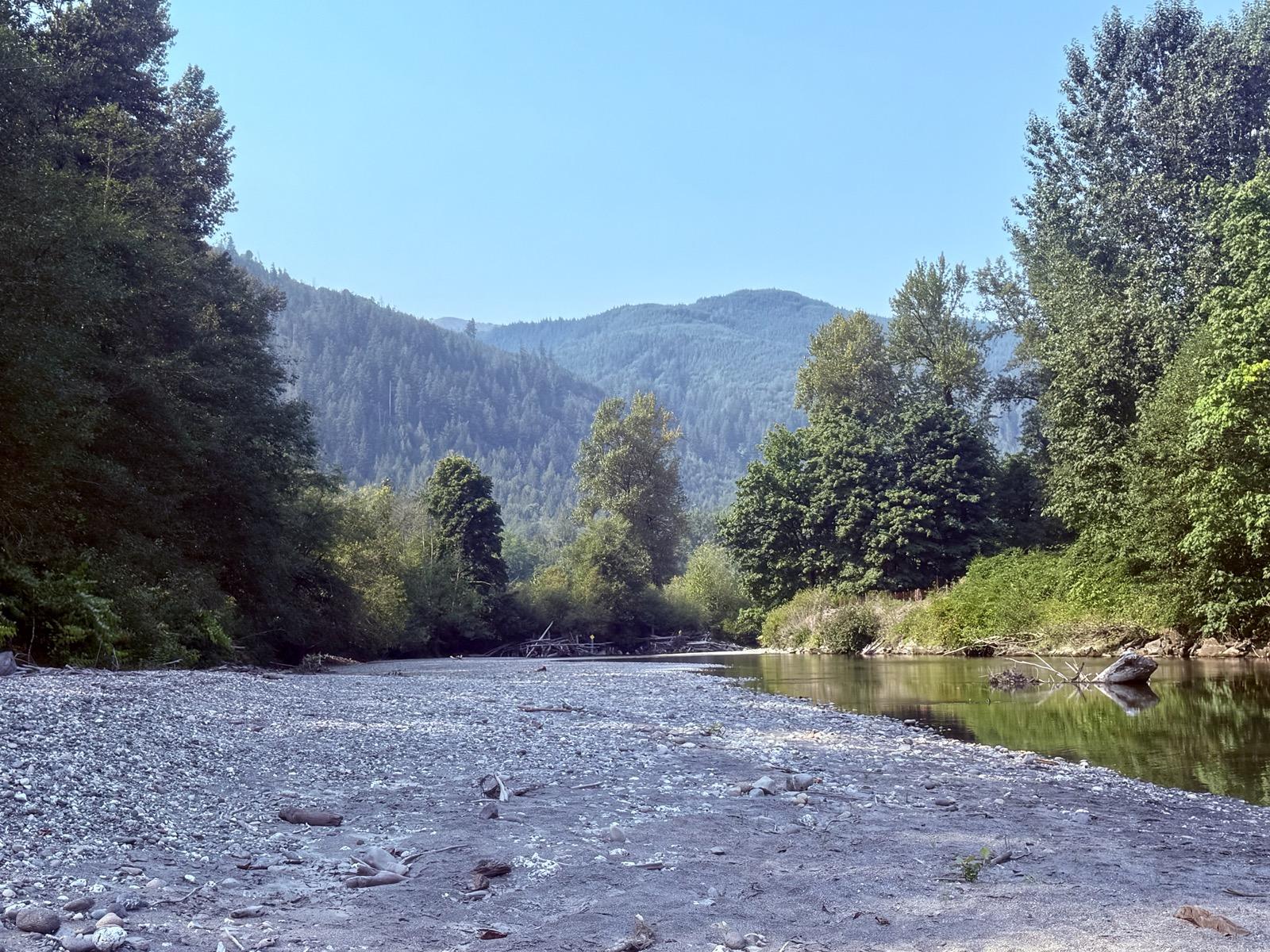
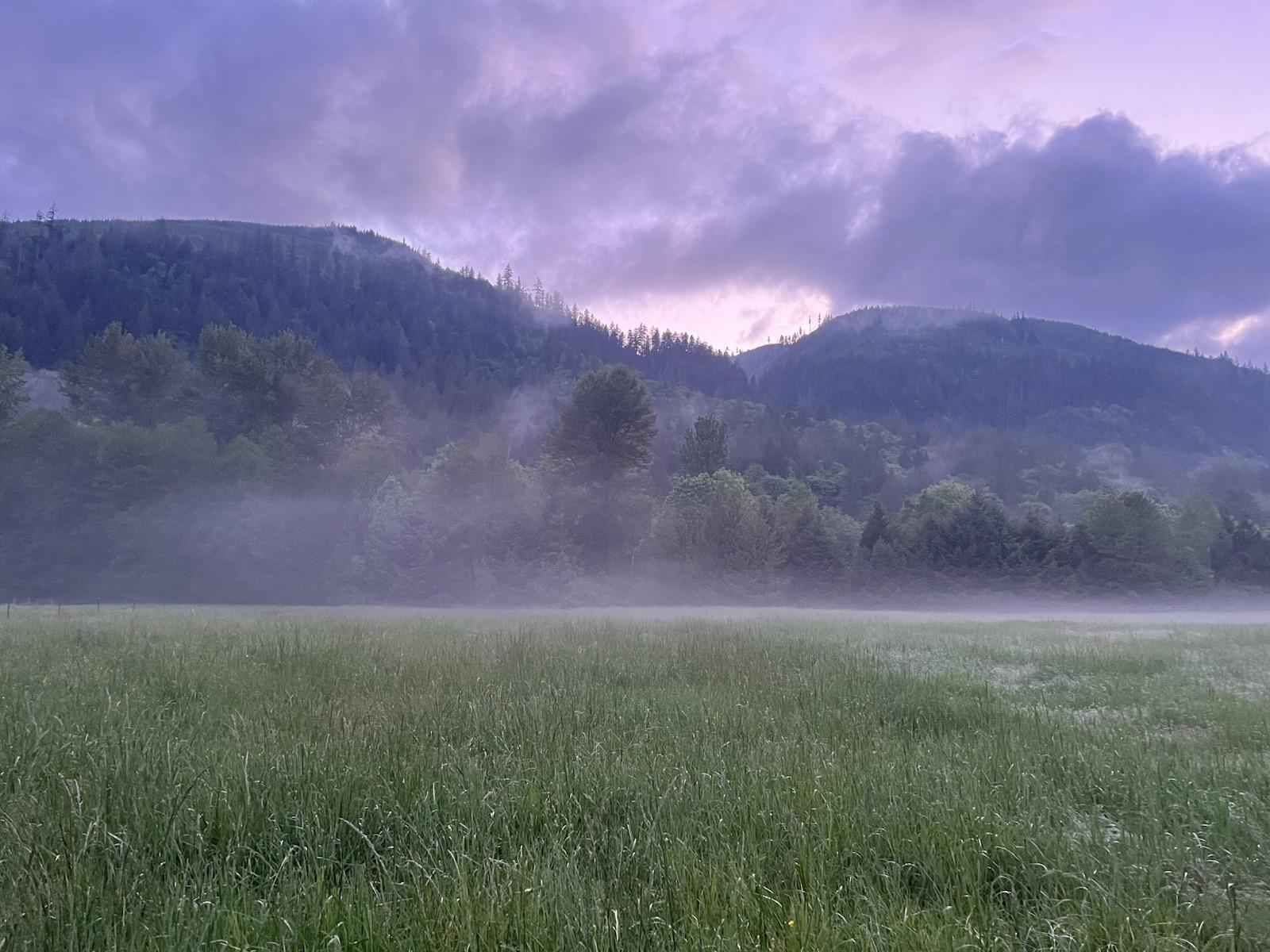
River Farm is an 80-acre cooperative 45 minutes east of Bellingham, part of the Evergreen Land Trust. We'll be on Turtle Island, a clearing at the center of the property with campsites, fire pit, covered stage, outdoor kitchen, and access to trails, a waterfall, and the South Fork of the Nooksack River.
River Farm is an amazing place to listen to water, see the stars, and feel bare feet on grass and moss. Part of what makes this gathering work is that the land does some of the processing for you. The conversations that feel overwhelming in the abstract feel different when you're having them next to a river, or after a morning hike to a waterfall. We plan to explicitly weave in time in nature as part of our collective work instead of treating it as an object we interact with when taking a break from the "real work."
Most people will camp, with options ranging from near the center of camp to deeper in the woods for those seeking quiet. We have limited yurt and cabin space for those with health considerations. If you need to borrow gear, we can help arrange it. We will follow up with a logistics guide as we get closer to the event.
The People and Conversations
We expect sessions to be emergent depending on the state of the world, the interests groups bring prior to the event, and the flow during camp. Based on last year and the current group, we anticipate engaging with the topics below. This list is a starting point.
Finding What's Yours to Tend and Grow
We are all doing something about climate or the broader crisis, but doing it scattered across different orgs, sectors, and strategies, often without a clear sense of how our piece connects. Often our version of engagement looks like rushing to every crisis. That's sometimes needed. But we'll also explore what it looks like to quietly plant things that need years to grow. What does it mean to find a political home, not necessarily an organization, but a place where your work plugs into something larger and where you can be replenished when things get hard?
Cascadia on Fire (and Flooding, and Shifting)
Each year, the chance of longer wildfire seasons and an intense heat dome increase. Snowpacks decrease, while insurance companies prepare to adjust their models to the new reality. The gap between what scientists are projecting and what our communities are ready for is the most important question, with the situation worsened by Federal defunding at every level. What would actual preparation look like: community infrastructure, resilience hubs, local networks that function when federal support doesn't? We'll work through what's possible at the levels we can actually access, from neighborhood to county to region.
Energy: Electrons, Bills, and Power
Historically, the Cascadia region had one of the cheapest and cleanest power in the country. Now as the ambitious energy transition is hitting a wall of shrinking capacity and massive cost increases, your utility bill is a political battleground. Who pays for the physical impact of climate change and the continuation of the energy transition? That's the fight playing out in every rate case and utility board meeting in the region. What would a system with more distributed power, both electrical and political, actually look like?
Stories, Models, and Frameworks
Who has thought about these problems before, how did they approach them, and what did they figure out? And what's your working model for understanding this moment? Last year we had a stack of books on the stage (and in the shade) that people came back to to read and relax. This year, we plan to build on those ideas with a pop-up library and dedicated structures for people to share books, ideas, organizations, and stories that bring them clarity, joy, or any range of intense emotions. We want people to come with (or start building) their own frameworks for understanding the moment we're in, and to leave with a bigger, more connected map.
Play and Connection
We're going to play in the woods, swim in the river, and spend real time being in our bodies, feeling the world and with each other. Some of this is organized by people who are good at getting adults to remember how to actually play. Some of it is just open time to go for a walk, sit by the water, have a conversation, or tell stories around a fire. Groups of us will also explore ways to use play and games as tools for thinking about futures, where you can try on what different scenarios actually feel like rather than just analyzing them.
Logistics, Expectations, and Shared Labor
We expect most people to leave from Seattle and aim to ensure everyone that is leaving from Seattle can get a carpool. If you are traveling from other areas, our ability to offer a carpool will depend on timing and people.
We're feeding 50-80 people outdoors for four days! A small team of volunteer coordinators will plan menus and lead meal prep. Everyone should expect to take at least one shift during the weekend: cooking, dishes, hauling water, or keeping shared spaces running. You'll sign up when you arrive. All meals are vegetarian with vegan options. There will be a space to let us know about dietary needs when you RSVP.
Lodging will be festival-style camping with amenities. Potable water, port-a-potties, one River Farm bathroom, parking arranged. Yurt/cabin space is limited and prioritized for health considerations.
If you are interested in taking a larger role as part of the coordination team, please note when you sign up through Luma.
Cost
Total cost: $50 to $250 sliding scale ($175 suggested).
- $50+ total: Whatever works
- $175+ total: Stable finances
- $250 total: Abundant finances
Fees cover the site, food for the weekend, and logistics. We break even at ~$175/person — paying above that directly makes it possible for someone who can't. If cost is a barrier, email us. No explanation needed.
Next Steps
RSVP to hold your spot on our Luma.
Bring someone: If you have a partner, friend, or colleague who should be here, send this their way.
Meet people beforehand: We'll host smaller gatherings between now and July. These will be chances to meet faces, ask questions, and arrive knowing some people. Details to come.
Questions? Issues with Luma or privacy concerns for registration? Email hello@ridgelinecollab.org
Specific schedule to come closer to the event. We'll share a detailed agenda as July approaches.
With care,
Alecia, Lowell, Sam, and Others!
Inspirations and Touchpoints
For a sense of what we're drawing on:
- How to Live Like the World is Ending — Margaret Killjoy
- Everything for Everyone — M.E. O'Brien & Eman Abdelhadi
- Practical Radicals — Deepak Bhargava and Stephanie Luce
- Decarbonization Series (Presentations) — Nate Bullard
- The Electrotech Revolution — Ember
- The All We Can Save Project — Dr. Katharine Wilkinson and Dr. Ayana Elizabeth Johnson (and others)
- Parable of the Sower (& Talents) — Octavia E. Butler
- Liberating Structures — Henri Lipmanowicz and Keith McCandless
- The Terraformers — Annalee Newitz
- Imaginable — Jane McGonigal
- The Transformational Framework